Life...
A Satirical Virtual Reality Experience

Project Summary
Work Type: Narrative VR Course Group Project
Duration: 7 Weeks
Team Size: 3 (Solo ownership of Room 1: The Room of Scares)
Skill Categories: Virtual Reality Development · Immersive Storytelling · Real-Time 3D (Unreal Engine 4) · Interaction Design · User Experience Design · Spatial Audio Design · Material & Texture Authoring · Skeletal Animation Integration · Blueprint Visual Scripting · 3D Asset Pipeline · Level Design · VR Locomotion · User Testing & Iteration
The Concept
Life: A Satirical VR Experience is a narrative-driven virtual reality journey through the human condition - from the terrors of early life, through the chaos of middle age, to the bittersweet illusion of peace at the end. Structured as three sequential, thematically distinct rooms, the experience uses horror, humor, and metaphor to invite reflection on how we navigate existence.
The piece is a meditation on impermanence: you search for keys, find doors, reach Nirvana — and then a giant hand squashes you flat.
Each team member owned the complete design, development, and art direction of one room. I was solely responsible for Room 1: The Room of Scares - the interactive horror environment representing the chaos and vulnerability of early life.
Room Architecture & Narrative Design
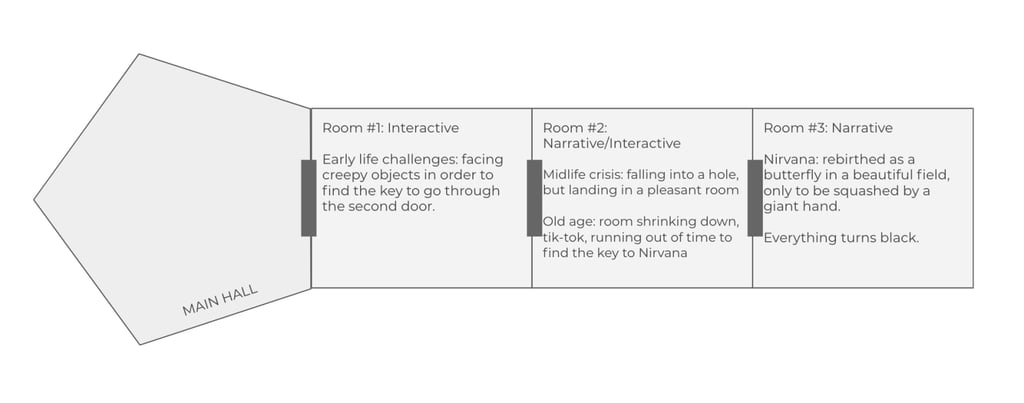
The experience is structured as three consecutive rooms, each representing a distinct life stage:
Room Life Stage Experience Type Theme
Room 1 Early life challenges Interactive Fear, discovery, survival
Room 2 Midlife crisis & old age Narrative + Interactive Achievement, urgency, time
Room 3 Nirvana Narrative Peace, transcendence and annihilation
Room 1: The Room of Scares (my contribution)
The user wakes in a dark room. A door waits ahead. To pass through, they must find a hidden key - but the room is alive with whispers, crawling things, and furniture that moves on its own. The interactive horror mechanics serve as a metaphor for confronting the unknown in early life.
Represents: Early life challenges
Objective: Find a key to open second door
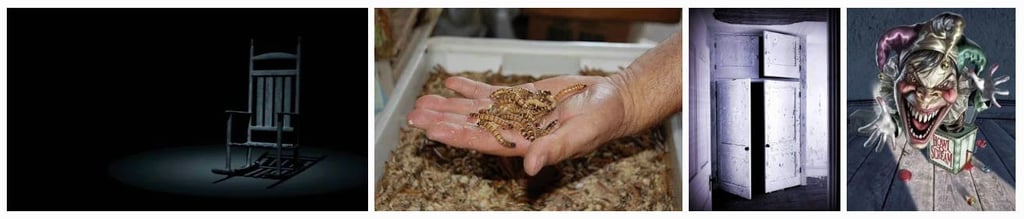
Objects: Drawers, chests, rocking chair, antique closets
Scares: Jack in the box, whispers, crawling hand, bugs
Spacial Audio: Whispering voices near the rocking chair and creepy background music
Room 2: The Library of Regrets
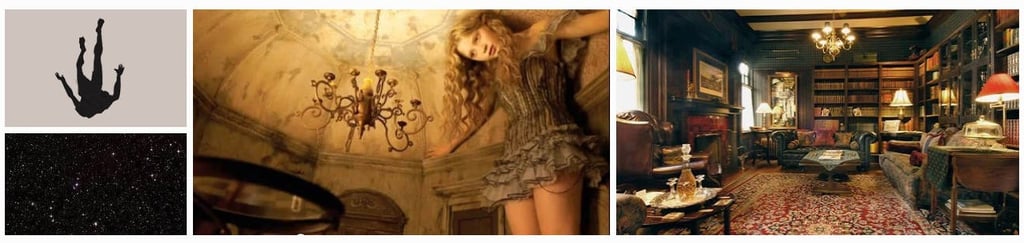
The user falls into an abyss and lands softly in a library filled with the achievements of a life well-lived. Classical music plays - until the room begins to shrink, a ticking clock fills the air, and time begins to run out.
Represents:
1. Midlife crisis: falling into a hole, but landing in a pleasant room
2. Old age: room shrinking down, tik-tok, running out of time to find the key to Nirvana
Setting: Participant falls into an abyss/ a hole but then lands softly in a library full of achievements
Objects: furniture, bookshelves, awards, diplomas
Interactions: Touches an object to open a secret door, gets message to find key
Spacial Audio:
calm classical music when landing in the library
Music stops, Tik-tok sound as room starts shrinking
Room 3: The Field of Nirvana
A serene meadow. Butterflies. Flowers. Nature sounds and the soft beat of wings. Then: darkness.
Represents:
Nirvana – rebirthed as a butterfly in a beautiful field, only to be squashed by a giant hand.
Everything turns black.
Objects: field, trees, flowers, butterflies
Spacial Audio:
Sounds of nature
Wings flapping
The Process
Environment Art & World Building
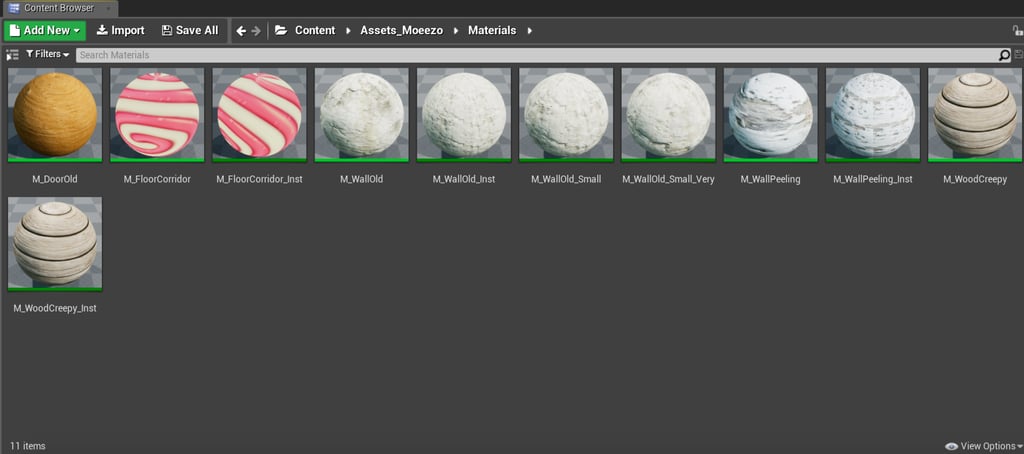
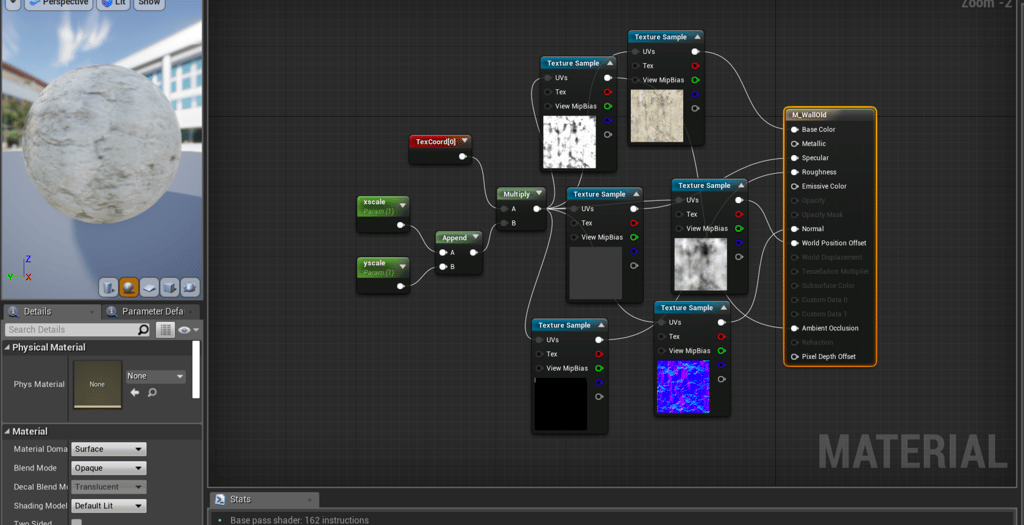
My first task was establishing the visual language of Room 1 - dark, oppressive, and tactile. I built custom materials in Unreal Engine 4 to achieve a weathered, aged aesthetic appropriate for an antique-horror setting.
Key materials created include:
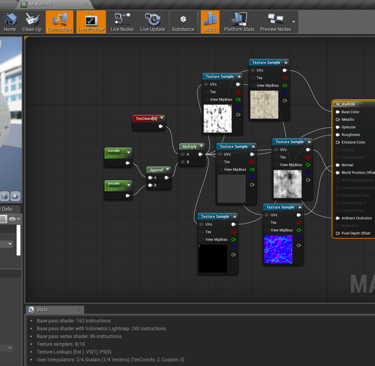
Aged wall plaster - layered color, roughness, and normal map inputs to simulate crumbling Victorian-era walls
Worn wood surfaces - used across drawers, chests, and floorboards
Closet and cabinet finishes - distressed finishes to reinforce narrative age and decay
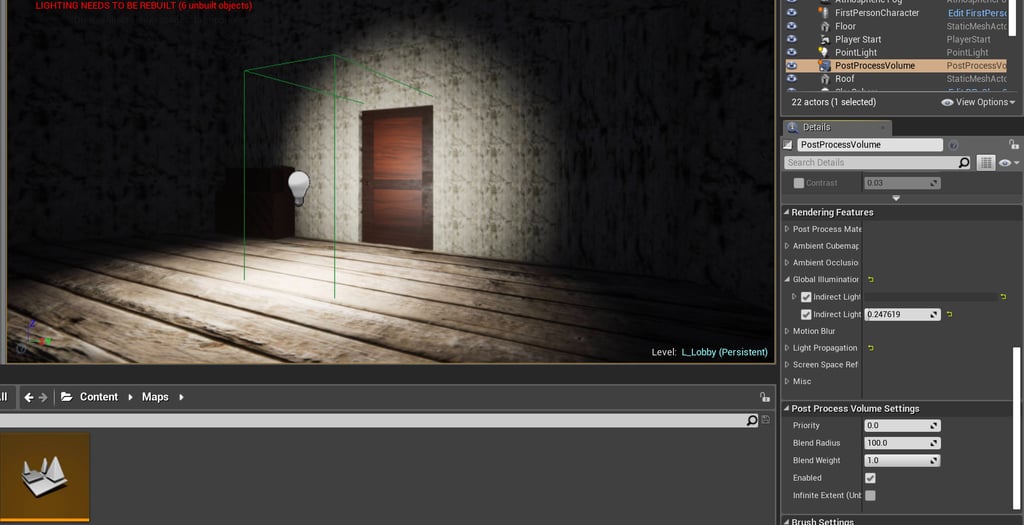
Post Processing Volumes were used to deepen the atmospheric darkness of the room and control contrast, reinforcing the tension of the environment without over-relying on lighting alone.
3D Asset Pipeline & Mesh Preparation
Assets were sourced from TurboSquid and Free3D, then processed and integrated into the Unreal Engine 4 pipeline.
A key technical challenge involved working with .obj format assets, which required a multi-step import workflow: importing the geometry separately, manually creating materials from the accompanying texture maps, and binding those materials to the mesh - in contrast to the more straightforward .fbx pipeline for other assets.
For interactive furniture like closets, drawers, chests, the rocking chair, I pre-processed meshes in Maya, separating moving components (doors, lids, drawers) from their parent meshes so that each element could be independently animated inside Unreal's Sequencer. This separation was essential to achieving believable, trigger-driven animations at runtime.
VR Spatial Design & Locomotion
After roughing in the room geometry, I conducted early-stage VR playtesting to validate spatial scale and sense of presence before committing to full asset placement. Getting the room to feel right in the headset, not just look right on a monitor, was a non-negotiable step in the process.
Locomotion was handled via teleportation using a NavMesh Bounds Volume. During testing, I identified an edge case: the door, set to Movable, was not blocking the NavMesh, allowing players to teleport outside the room while the door was closed. I resolved this by placing a hidden static wall behind the closed door that was removed programmatically when the door opened, a clean, non-intrusive fix that preserved player immersion.
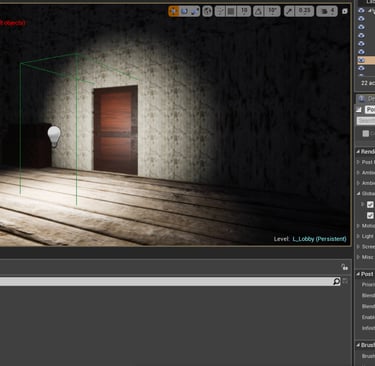
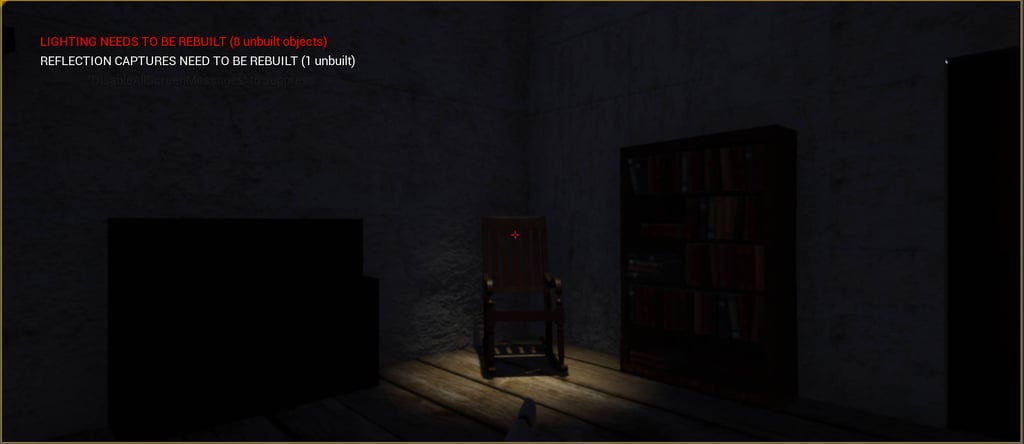
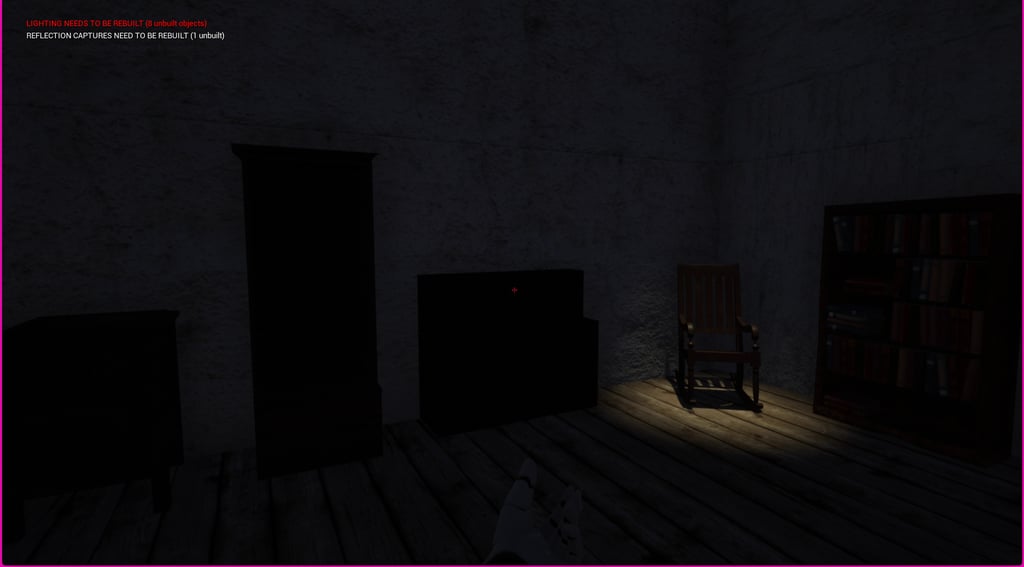
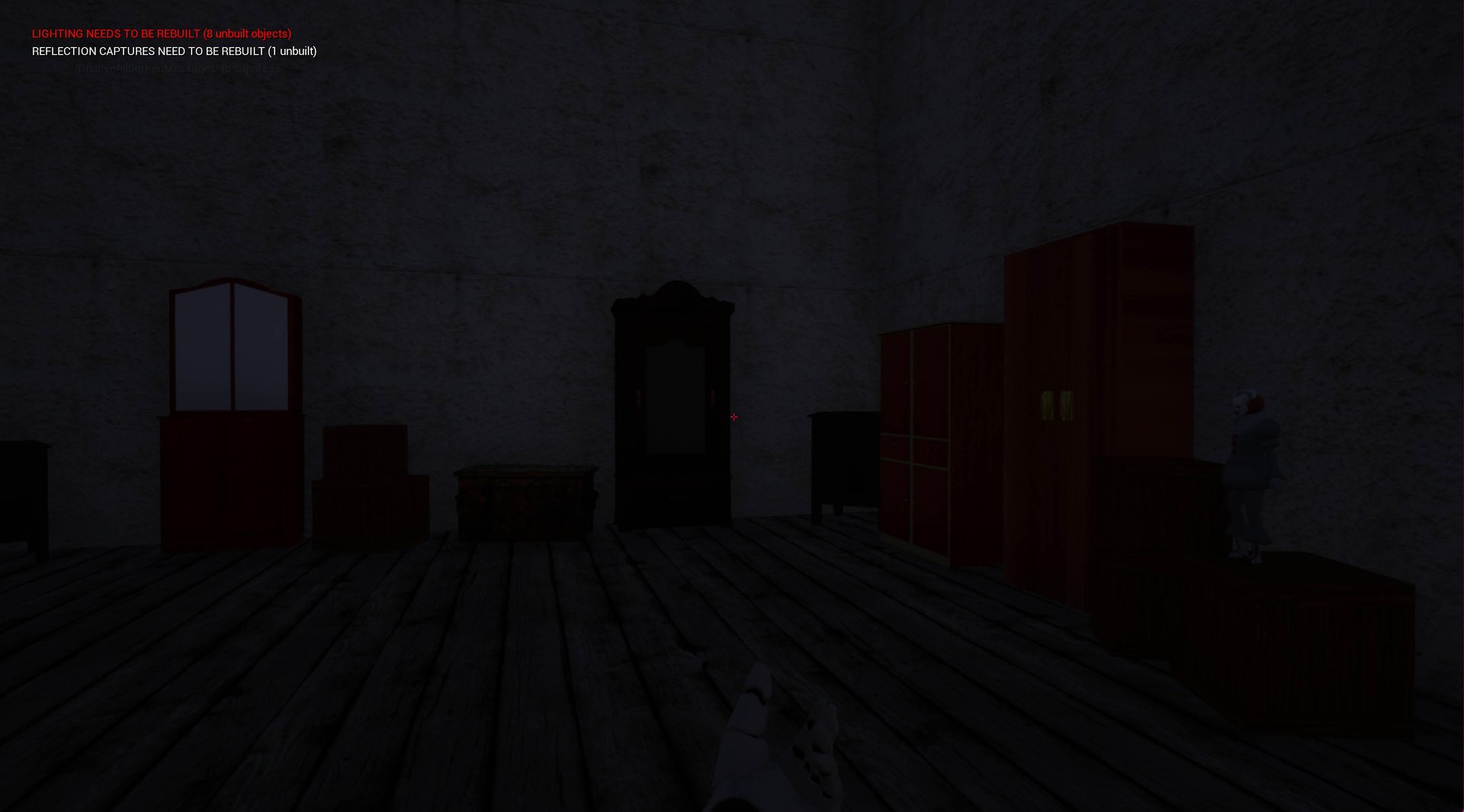
Screenshots of the room
Spatial Audio Design
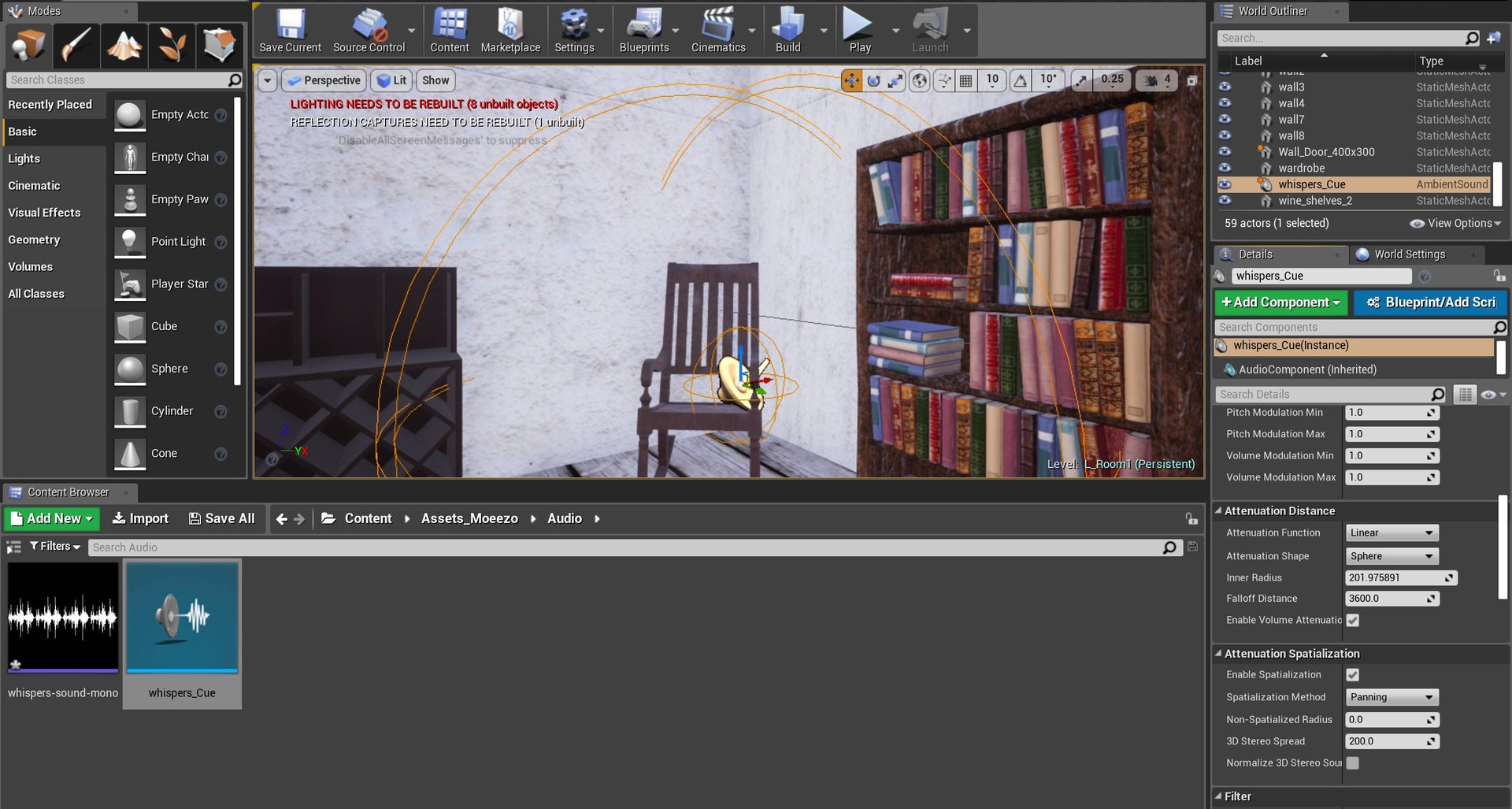
Sound is the invisible layer of presence in VR. For Room 1, I designed and implemented a spatial audio system centered around the rocking chair, the room's primary point of intrigue.
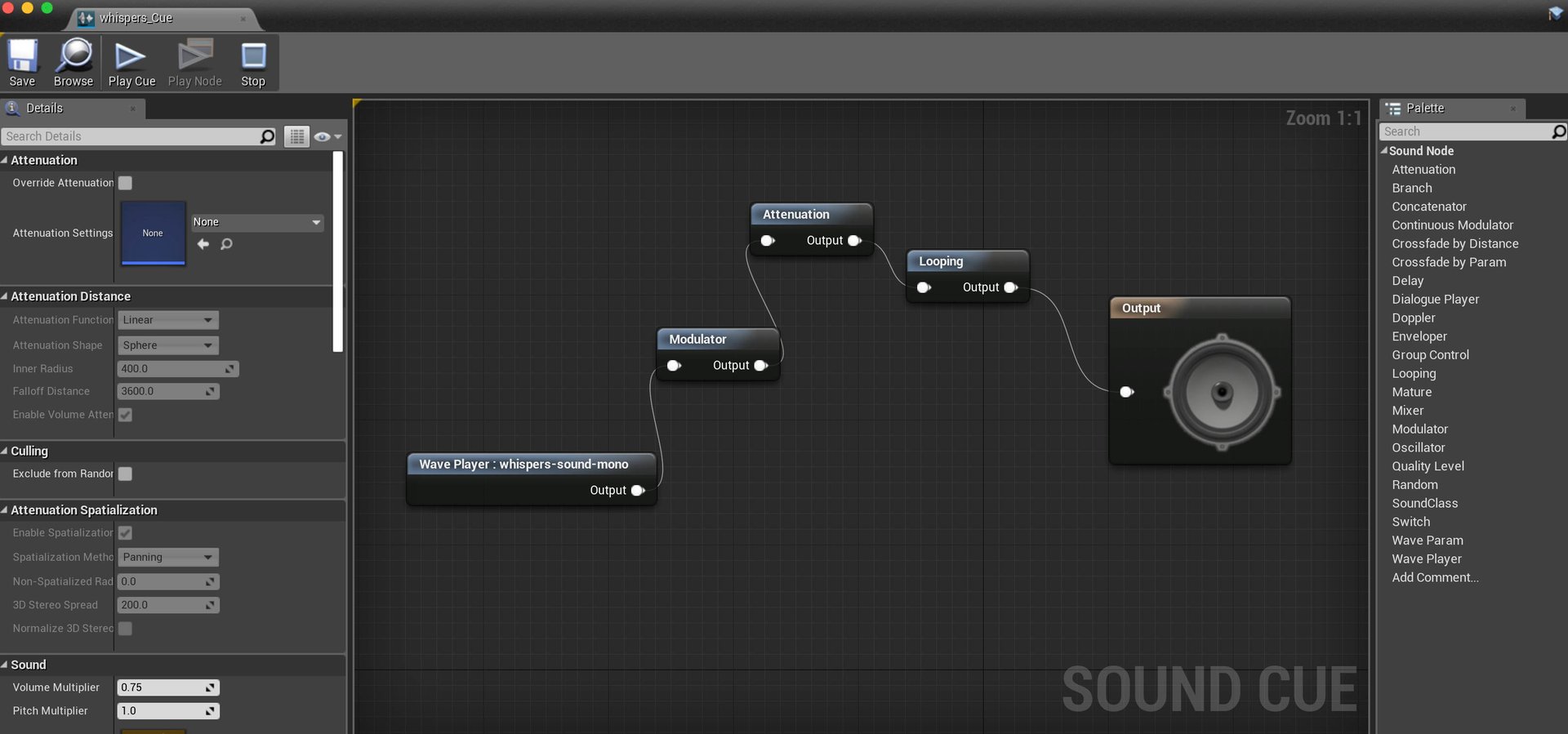
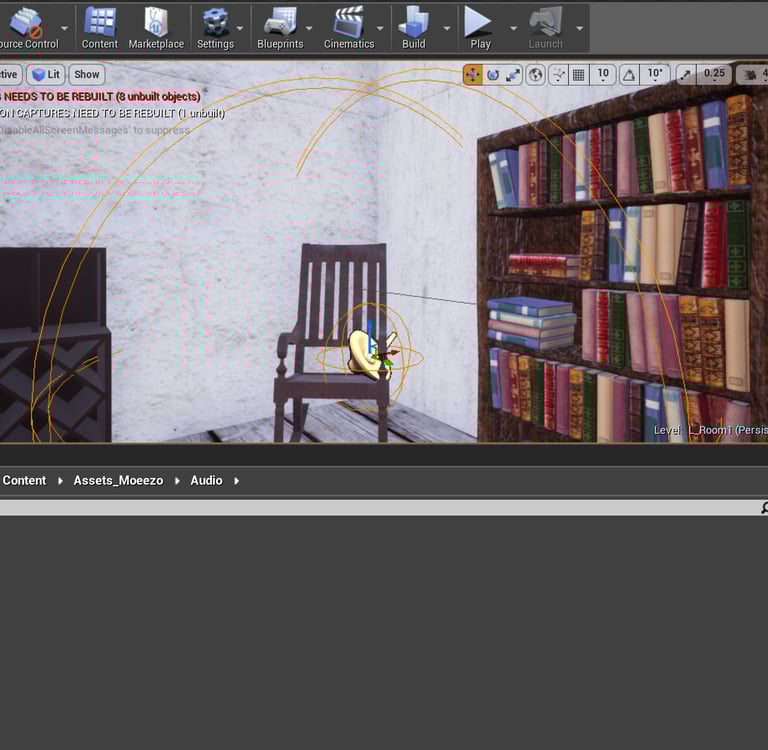
A creepy whispering audio track was sourced from Youtube, normalized to -0.1dB, converted to mono, and imported into Unreal Engine 4 as a Sound Cue. Custom attenuation settings were configured so that the whispers are inaudible from a distance and only become perceptible as the player approaches the chair, creating a pull of curiosity that guides exploration without explicit prompting.
A spotlight above the chair reinforces this draw, functioning as both a gameplay affordance and a storytelling device.
Below is a video of the effect I was able to achieve (Note: I have disabled the post processing volume effects for this video).
Interaction Design & Blueprint Systems
At the beginning of the experience, the user finds themselves in a dark room with a door directly in front of them, therefore, one of the first interactions I added was the user's interaction with the door.
A short video of the first iteration of this interaction is given below.
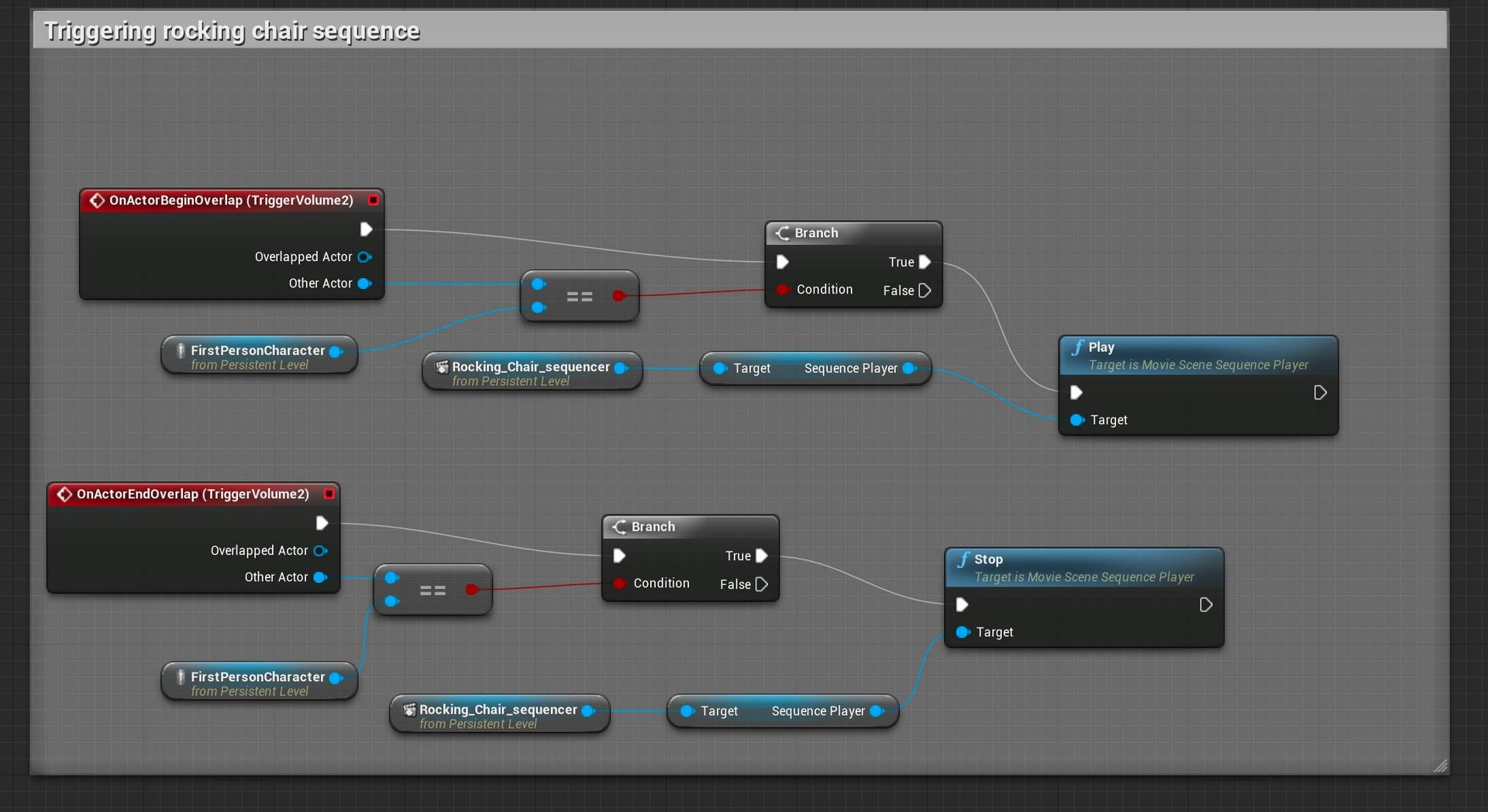
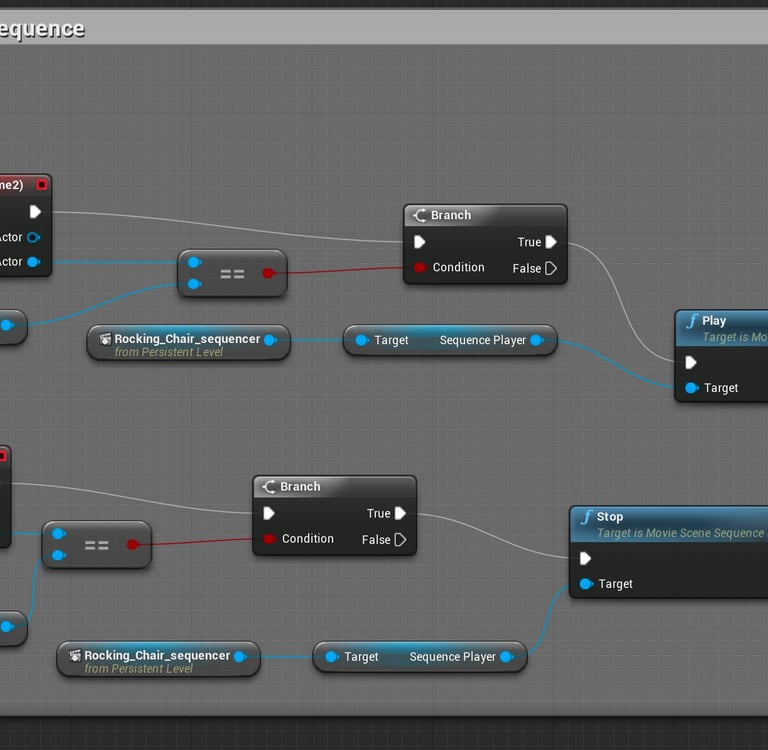
All player interactions were built using Unreal Engine 4's Blueprint visual scripting system, using Trigger Boxes, Sequencer animations, and Level Blueprint logic.
Rocking Chair A trigger box in front of the chair activates a looping rocking animation when the player enters the zone, giving the impression of recent occupation.
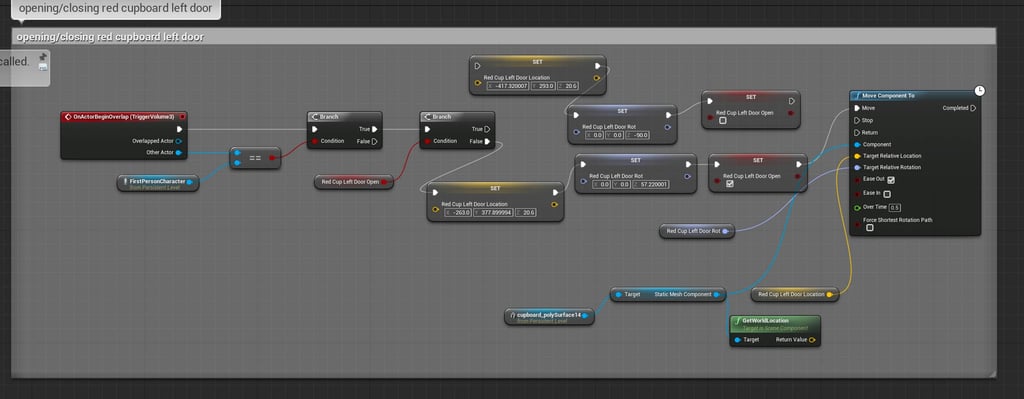
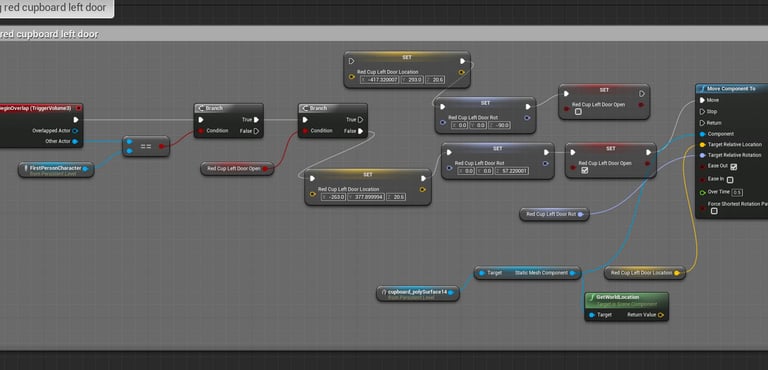
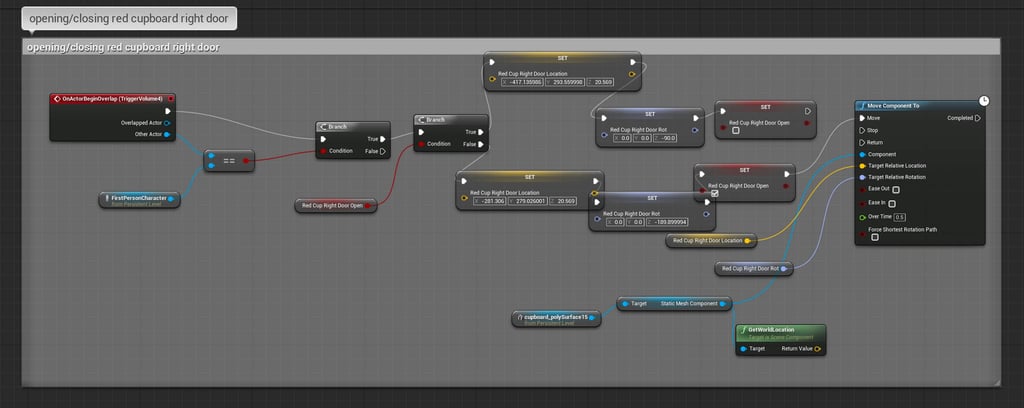
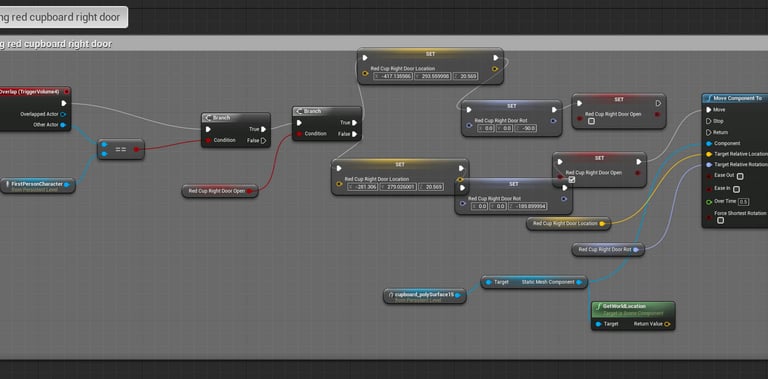
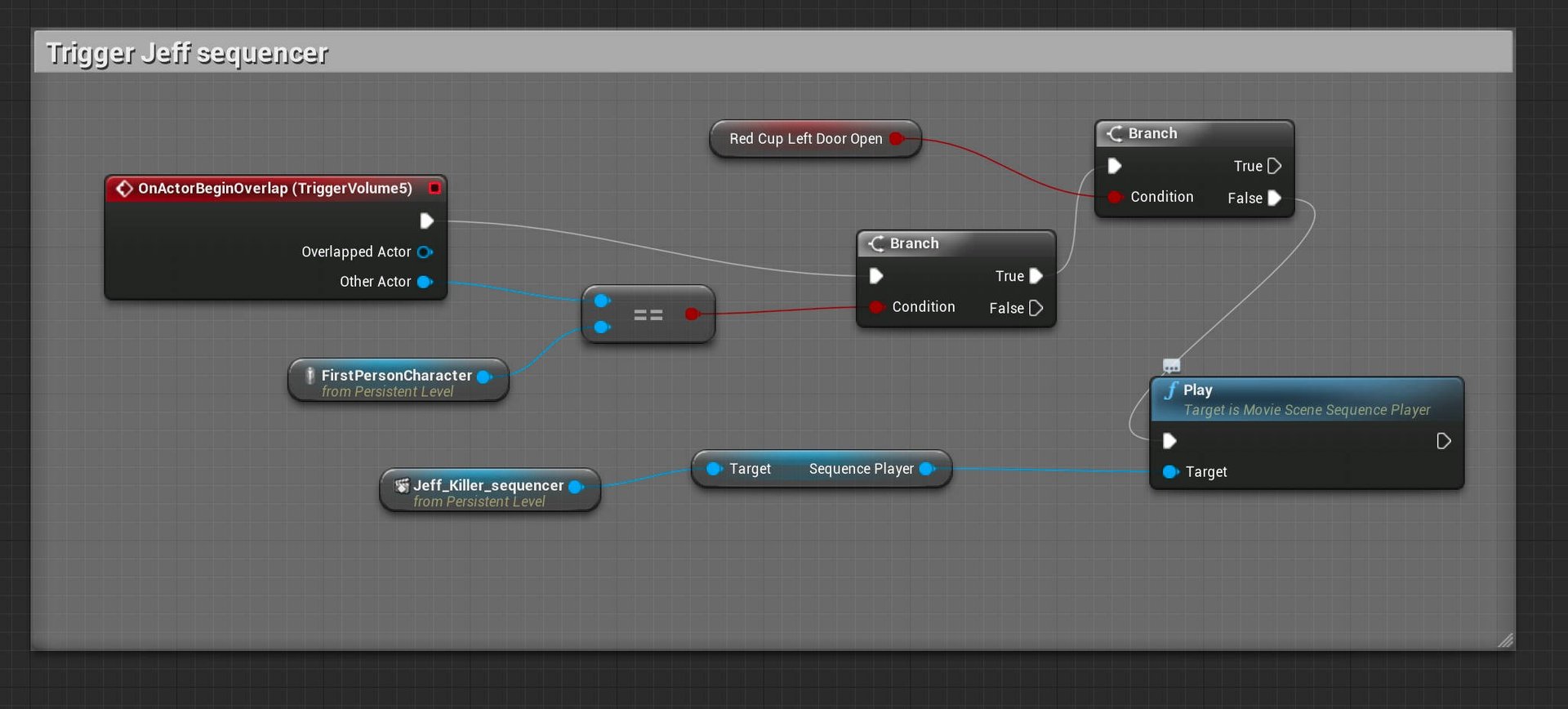
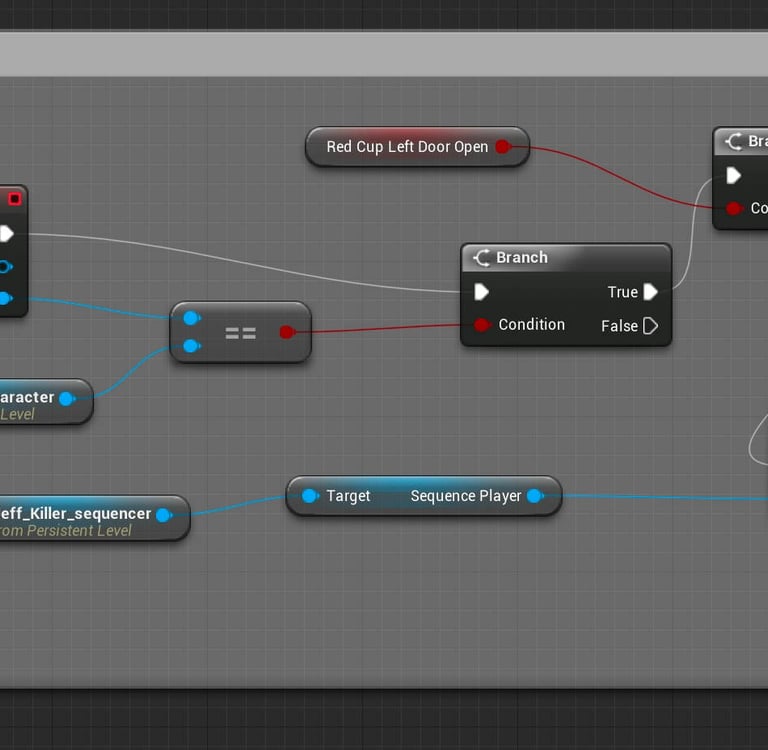
Red Closet / Jeff the Killer This was the most complex interaction in the room. Three independent trigger boxes were used: one for the left door, one for the right door, and one for the skeletal mesh animation of the figure emerging from within. The figure (a rigged skeletal mesh with animations created in Mixamo) plays a composite animation sequence through the Level Sequencer. A Boolean variable (LeftDoorOpen) ensures the jump scare triggers exactly once per session, preventing repetition that would break immersion.
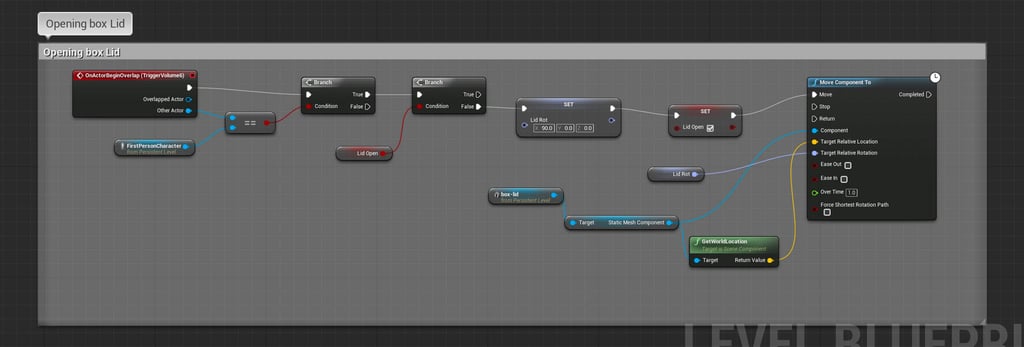
Blueprints for the doors and Jeff the Killer.
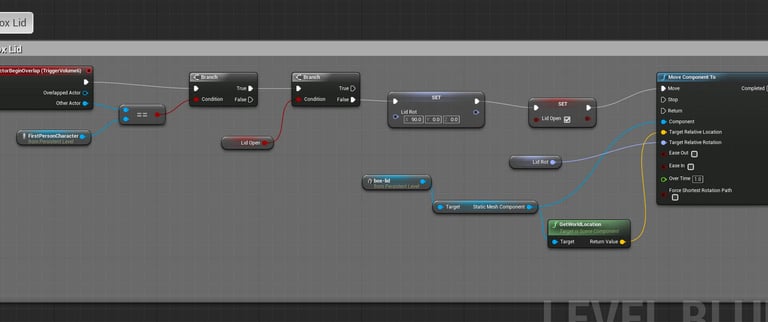
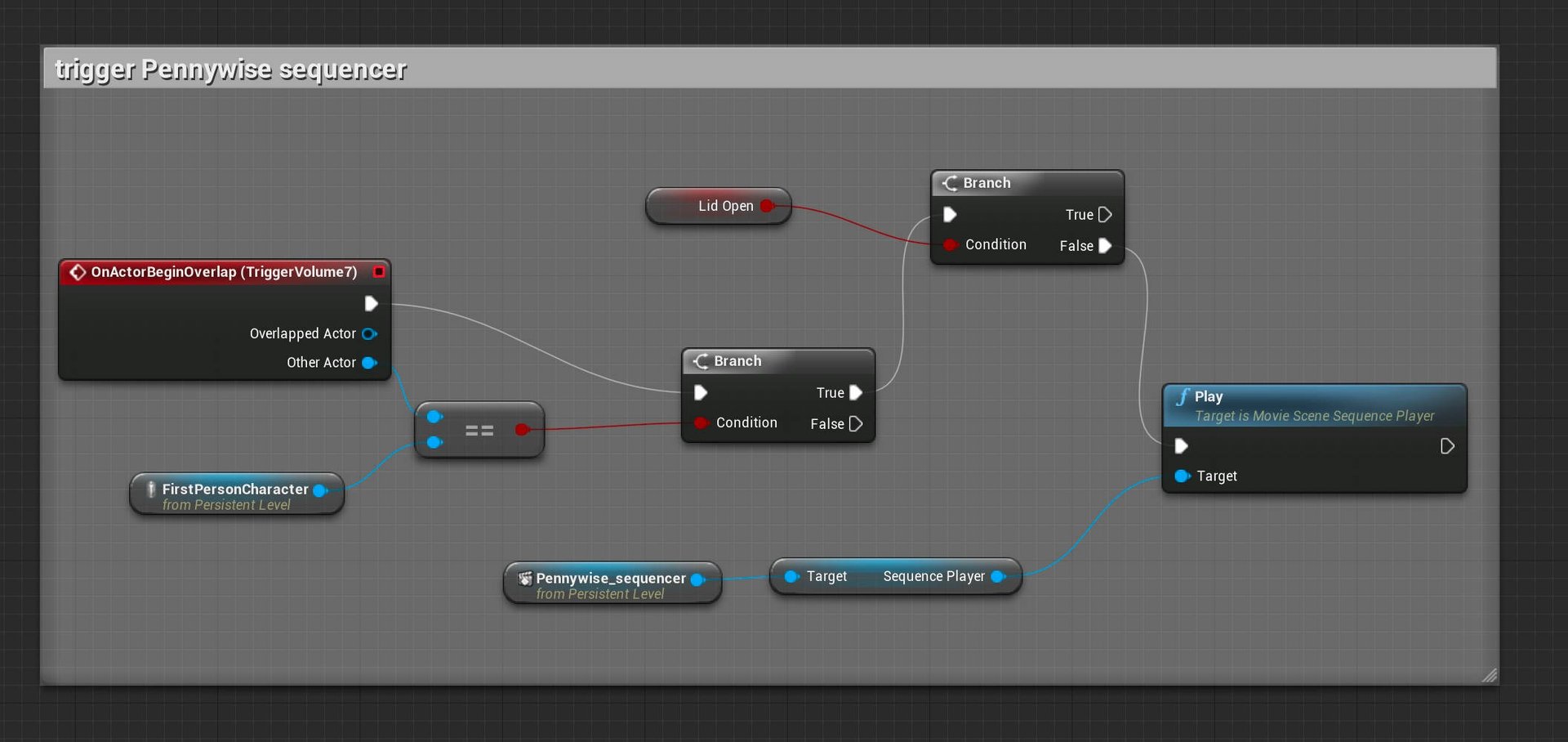
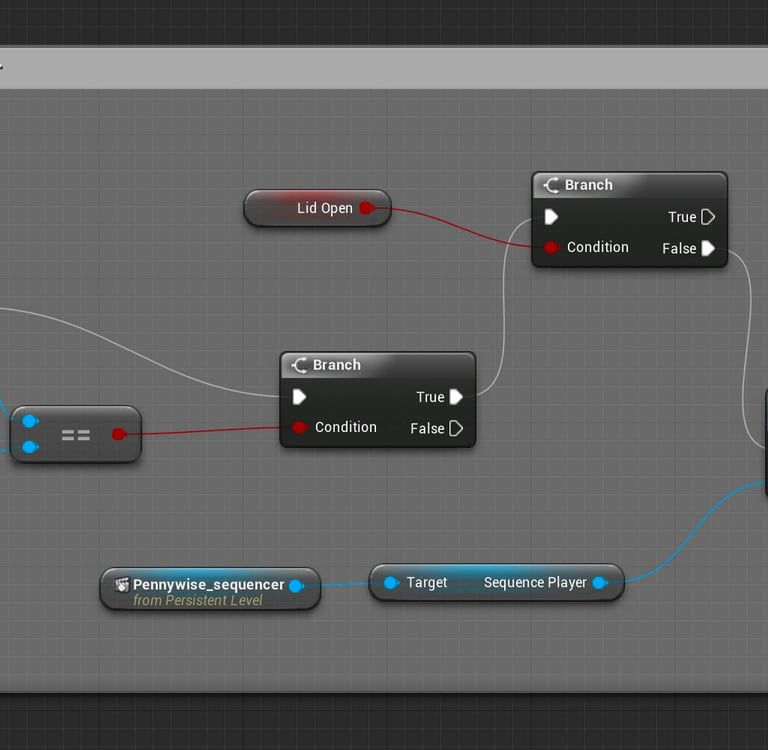
Chest / Pennywise Clown A simpler trigger-box interaction toggles the chest's lid-opening animation and a character animation in sequence.
Below is a screen recording of the interactions.
Key Retrieval & Puzzle Completion
The room's core objective, finding the key to exit, is gated behind the most interactive element: a drawer inside a closet, guarded by animated spiders. A hasKey Boolean variable tracks whether the player has retrieved the key, and the exit door only responds to interaction when this value is true.
To support new players during testing, a contextual message ,"You can go through the door", appears once the key is obtained, guiding completion without breaking the fiction.
User Testing & Iteration
User testing revealed two critical UX issues:
Issue 1: Key Visibility The key's dark color caused it to blend into the dim environment, and several testers missed it entirely. Resolved with contextual on-screen messaging triggered at the moment of retrieval.
Issue 2: Interaction Legibility Players had no reliable way to identify which objects were interactive. In the absence of a traditional UI (a deliberate VR design choice), I added pulsating spotlights above each interactive object. This was a diegetic affordance that invites exploration while maintaining the atmospheric integrity of the room.
Level Integration & Multi-Room Architecture
Once all three rooms were complete, the team combined individual levels using Unreal Engine 4's Level Streaming system, triggered via Blueprint from a persistent level. This approach kept each room's assets isolated and manageable while allowing seamless transitions between all three environments at runtime.
Screen recording of the complete experience (all three rooms) is given below.
Technologies Used
Unreal Engine 4: Level design, Blueprint scripting, Sequencer animation, Post Processing, Navmesh, Level Streaming
Maya: Mesh separation and preparation for interactive asset animation
Mixamo: Skeletal animation rigging and animation creation
Unreal Sound Cue Editor: Spatial audio design and attenuation configuration
TurboSquid / Free3D: 3D asset sourcing
VR Hardware: Oculus Rift S, In-headset playtesting for spatial scale and presence validation
Outcomes & Reflections
This project pushed me to work simultaneously across disciplines that in larger studios would typically belong to separate specialists; environment artist, interaction designer, audio designer, and gameplay programmer. Owning a complete room end-to-end gave me hands-on experience with the full creative-to-technical pipeline of real-time VR development.
The experience also deepened my thinking about diegetic UX in immersive environments; how affordances, lighting, and sound can guide users without breaking presence, and why standard UI conventions often fail in VR contexts.
Future Perspectives
Given more time and scope, the experience could be extended in several directions:
Haptic feedback integration to amplify the scare interactions and increase embodiment
Procedural or randomized scare placement to create replay variation and prevent pattern recognition
Gaze-based interaction as an alternative to proximity triggers, enabling subtler and more tension-building affordances
Expanded narrative branching in Room 2, allowing players to make choices that affect the ending, transforming the piece from linear narrative into interactive storytelling
Optimization and porting to standalone headsets (Meta Quest) to expand accessibility and audience reach